The full conference schedule is now online.
The 5th Paris Conference on Education (PCE2026)

June 15-19, 2026 | Sorbonne University International Conference Center (CICSU), Paris, France (& Online)
Bienvenue à Paris!
Welcome to the Paris Conference on Education (PCE2026), held as a part of IAFOR’s European Conference Series and hosted at the Sorbonne University in 2026.
 For centuries, France and its capital, Paris, have been a global intellectual and cultural centre and crossroads, impacting ideas, trends, theories, and practices, in all fields both in and the academy and the wider society. It remains the world’s most influential arbiter of taste, not only in food and wine, but also in fashion and style. This incredibly beautiful city, with its monumental buildings and sweeping designs, has been a literal and metaphorical stage for literal and metaphorical battles of ideas, of systems, of religions, and of countries that have themselves had enormous global ramifications, for good and for bad. The theories and the practices debated and implemented here, and the reforms and revolutions of Paris, have influenced and ignited those around the world.
This storied heritage attracts students and academics from around the world to its leading educational and research institutions, museums, and collections, and while Paris draws on its imposing traditions and cultural heritage, it is a place and space of constant renewal and innovation.
Through its geographically central but open and exposed position, Paris has hosted meetings between nations, cultures, and disciplines for more than two millennia; its historical and cultural richness is a result of these meetings. It is within this intellectual tradition, space, and place that we situate our own event here, in line with the IAFOR mission of ‘encouraging interdisciplinary discussion, facilitating intercultural awareness and promoting international exchange’.
The 5th Paris Conference on Education (PCE2026) is an interdisciplinary conference held alongside The 5th Paris Conference on Arts & Humanities (PCAH2026). Registration for any of these conferences will allow delegates to attend sessions in the other. In keeping with our mission, we open the plenary sessions to all delegates across the conferences. We do this as every individual delegate has their own different overlapping interests.
We look forward to welcoming you (back) to Paris!
– The PCE2026 Programme Committee
Key Information
- Location & Venue: Sorbonne University International Conference Center (CICSU), Paris, France
- Dates: Monday, June 15, 2026 to Friday, June 19, 2026
- Early Bird Abstract Submission Deadline: January 15, 2026*
- Final Abstract Submission Deadline: March 20, 2026
- Registration Deadline for Presenters: April 30, 2026
*Submit early to take advantage of the discounted registration rates. Learn more about our registration options.
Call for Papers
The PCE Programme Committee welcomes papers from a wide variety of interdisciplinary and theoretical perspectives, and submissions are organised into the following streams:
- Teaching & Learning
- Educational Structures
- Community & Society
- Language & Culture
- Psychology, Mind & Brain
- Innovation & Technology
- Special Themes and Areas of Focus
Upon abstract submission, authors will have the opportunity of identifying whether their paper addresses either the IAFOR Special Theme and/or one of the ongoing IAFOR Special Areas of Focus.
Speakers
-
 Olivier GuilletInstitut Supérieur du Droit, France
 -
Donald E. HallBinghamton University, United States
-
Brendan HoweEwha Womans University, South Korea
-
Lori MaguireUniversity of Reims Champagne-Ardenne, France
-
Ljiljana MarkovicEuropean Centre for Peace and Development (ECPD), Serbia
-
Andrew J. M. SmithEmporia State University, United States
-
François TaddeiLearning Planet Institute, France





IAFOR's Conference Themes for 2025-2029
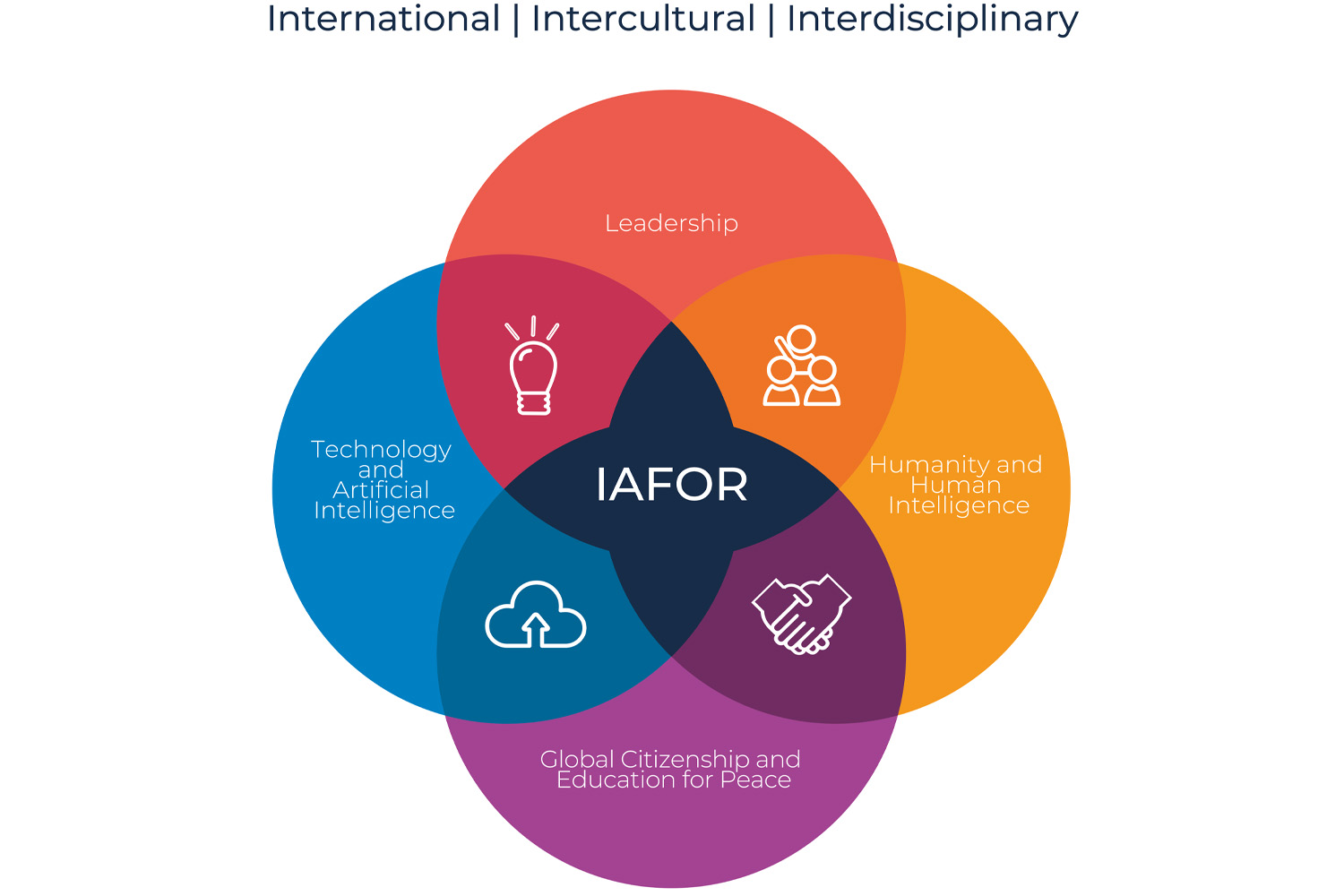
Our selected themes for 2025-2029 bring together ideas and encourage research and synergies in the following areas:
Technology and Artificial Intelligence
Humanity and Human Intelligence
Global Citizenship and Education for Peace
Leadership
Our four themes can be seen as standalone themes, but they are also very much in conversation with each other. Themes may be seen as corollaries, complementary, or in opposition/juxtaposition with each other. The themes can be considered as widely as possible and are designed, in keeping with our mission, to encourage ideas across the disciplines.
Read Last Year's Conference Report
Conference News



Sponsorship & Exhibition
About IAFOR’s Education Conferences
IAFOR promotes and facilitates new multifaceted approaches to one of the core issues of our time, namely globalisation and its many forms of growth and expansion. Awareness of how it cuts across the world of education, and its subsequent impact on societies, institutions and individuals, is a driving force in educational policies and practices across the globe. IAFOR’s conferences on education have these issues at their core. The conferences present those taking part with three unique dimensions of experience, encouraging interdisciplinary discussion, facilitating heightened intercultural awareness and promoting international exchange. In short, IAFOR’s conferences on education are about change, transformation and social justice. As IAFOR’s previous conferences on education have shown, education has the power to transform and change whilst it is also continuously transformed and changed.
Globalised education systems are becoming increasingly socially, ethnically and culturally diverse. However, education is often defined through discourses embedded in Western paradigms as globalised education systems become increasingly determined by dominant knowledge economies. Policies, practices and ideologies of education help define and determine ways in which social justice is perceived and acted out. What counts as "education" and as "knowledge" can appear uncontestable but is in fact both contestable and partial. Discourses of learning and teaching regulate and normalise gendered and classed, racialised and ethnicised understandings of what learning is and who counts as a learner.
In many educational settings and contexts throughout the world, there remains an assumption that teachers are the possessors of knowledge which is to be imparted to students, and that this happens in neutral, impartial and objective ways. However, learning is about making meaning, and learners can experience the same teaching in very different ways. Students (as well as teachers) are part of complex social, cultural, political, ideological and personal circumstances, and current experiences of learning will depend in part on previous ones, as well as on age, gender, social class, culture, ethnicity, varying abilities and more.
IAFOR has several annual conferences on education across the world, exploring common themes in different ways to develop a shared research agenda which develops interdisciplinary discussion, heightens intercultural awareness and promotes international exchange.
About IAFOR
"International, Intercultural, Interdisciplinary"
Founded in 2009, The International Academic Forum (IAFOR) is a global interdisciplinary scholarly association that brings together scholars from around the world. Through research collaborations, publications, and international conferences, it connects academics across disciplines and regions. IAFOR's main administrative office is in Nagoya, Japan, and its research centre (The IAFOR Research Centre) is in the Osaka School of International Public Policy (OSIPP), a graduate school of The University of Osaka. Through its international, intercultural and interdisciplinary conferences, research, and publications, IAFOR is a network hub for interdisciplinary discussion across Asia and beyond.
IAFOR Main Site | IAFOR Research Archive | IAFOR Research Centre