
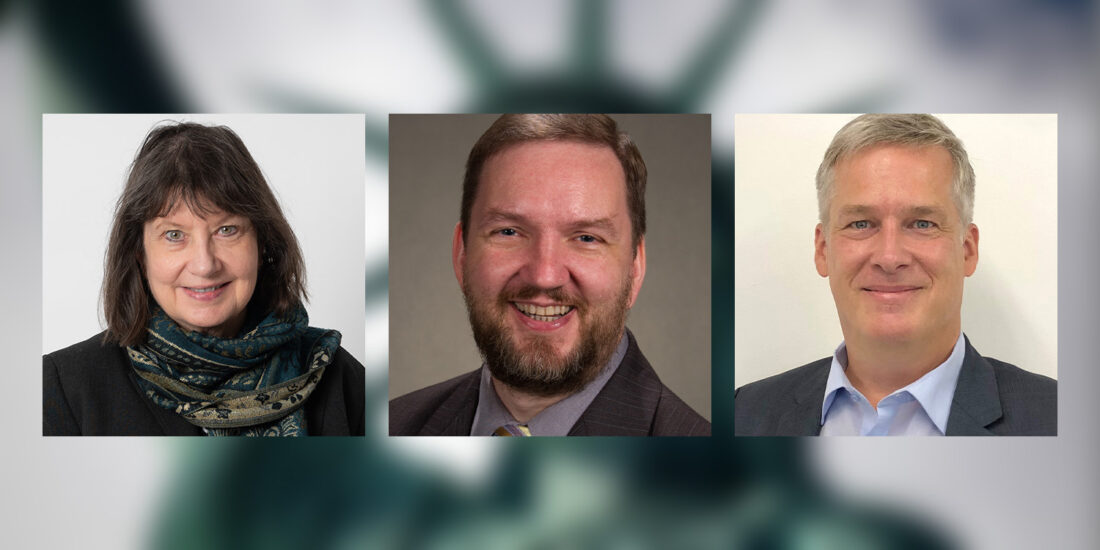
Professor Lori Maguire of Université de Reims Champagne-Ardenne, France, Dr Andrew J. M. Smith of Emporia State University, United States, and Professor Brendan Howe of Ewha Womans University, South Korea, will present on the featured panel discussion titled ‘250 Years of Rights Promotion and Cooperation’ at The 5th Paris Conference on Education (PCE2026) and The 5th Paris Conference on Arts & Humanities (PCAH2026) in Paris, France.
The panel discussion marks the 250th anniversary of the Declaration of Independence, and explores the historical partnership between France and the United States and their shared influence on democratic governance and the liberal international order. Speakers will examine the global legacy of the American and French Revolutions, contemporary challenges posed by populism and unilateralism, and whether the United States is retreating from its longstanding role as a global normative leader.
This keynote presentation will be held both onsite in Paris and online via live-stream. To participate in PCE/PCAH2026 as an audience member, please register for the conference via the conference website.
The presentation will also be available for IAFOR Members to view online as part of their membership benefits. To find out more about becoming an IAFOR Member, please visit the IAFOR Membership page.
Speaker Biography
Lori Maguire
Université de Reims Champagne-Ardenne, France
 Dr Lori Maguire is full professor of British and American Studies at Université de Reims Champagne-Ardenne, France, a member of the editorial board of Cold War History, and a senior review editor for H-Diplo. She has published extensively both in French and English. Her main focus has been on the cultural history and foreign policy of Britain, France, and the United States and their relations with each other. Her book, A History of the Cultural Cold War, should come out at the end of this year. Her most recent publications include Consuls in the Cold War with Sue Onslow (Brill, 2023); “To Stay or Not to Stay: The United States Consulate in Hà Nội, 1954–1955”, Journal of Vietnamese Studies (2023); and “The Diplomatic Departure from Limbo: Three Valedictory Despatches by British Consuls in Hanoi during the Period of the Vietnam War”, Contemporary British History (2023).
Andrew J. M. Smith
Emporia State University, United States
 Dr Andrew J. M. Smith is an Associate Professor in the School of Library and Information Management (SLIM) at Emporia State University in Kansas, United States. He studied at the University of St. Andrews, Scotland, Georgia State University, United States, and the University of Aberystwyth in Wales. He was a Robert T. Jones Memorial Scholar at Emory University in Atlanta and is an elected Visiting Professor at both the University of Belgrade in Serbia and The European Centre for Peace and Development.
Dr Smith has taught widely in the field, currently concentrating on collection development, library advocacy, indexing, genealogy and music librarianship. He developed Emporia State University’s Global Experience programme and has led 20 international trips where students study librarianship in different cultures. His current interests include accessibility as an essential element of equity in information provision, open access materials for teaching and scholarship, genealogical information provision, and grass-roots digitisation.
Brendan Howe
Ewha Womans University, South Korea
 Dr Brendan Howe is Professor of the Graduate School of International Studies, Ewha Womans University, South Korea, where he has also served as Dean, Associate Dean, and Department Chair. He is the President of the Asian Political and International Studies Association (APISA), and has been elected to serve as the President of the World International Studies Committee from July, 2025. He is currently a Humboldt Foundation Research Fellow at Heidelberg University, Germany, from 2025 through 2026. He has held visiting professorships and research fellowships at the East-West Center as a POSCO Visiting Research Fellow (United States), the Freie Universität Berlin (Germany), De La Salle University (Philippines), The University of Sydney (Australia), Korea National Defence University (South Korea), Georgetown University (United States), Universiti Malaysia Sarawak (Malaysia), and Beijing Foreign Studies University (China).
Educated at the University of Oxford, the University of Kent at Canterbury (United Kingdom), Trinity College Dublin (Ireland), and Georgetown University (United States), his ongoing research agendas focus on traditional and non-traditional security in East Asia, human security, middle powers, public diplomacy, post-crisis development, comprehensive peacebuilding, and conflict transformation. He has authored, co-authored, or edited around 150 related publications, including Comprehensive Peacebuilding on the Korean Peninsula (Springer, 2023), Society and Democracy in South Korea and Indonesia (Palgrave, 2022), The Niche Diplomacy of Asian Middle Powers (Lexington Books, 2021), UN Governance: Peace and Human Security in Cambodia and Timor-Leste (Springer, 2020), Regional Cooperation for Peace and Development (Routledge, 2018), National Security, State Centricity, and Governance in East Asia (Springer, 2017), Peacekeeping and the Asia-Pacific (Brill, 2016), Democratic Governance in East Asia (Springer, 2015), Post-Conflict Development in East Asia (Ashgate, 2014), and The Protection and Promotion of Human Security in East Asia (Palgrave, 2013).

Abstract
250 Years of Rights Promotion and Cooperation
The year 2026 marks 250 years since the Second Continental Congress adopted the Declaration of Independence of the United States on July 4, 1776. France has been a staunch ally of the US for most of the intervening years, being the first country to recognise American independence, and, in 1778, to sign an alliance with the fledgling country. The impact of the American Revolution against the external rule of the British king, and the subsequent French Revolution against domestic royal tyranny, has done much to shape the nature of principles of governance, both domestic and international. The US was to serve as a ‘shining city on a hill’ – an inspiration for other oppressed peoples, while the Liberté, Égalité, Fraternité motto of the French Revolution and Republic has served as a similar source of inspiration. Importantly, both countries were supportive of each other's revolutions. Yet this 250th anniversary is as much cautionary as it is celebratory.
Are the domestic and international governance principles that made the US a shining city on a hill a thing of the past? The second administration of President Donald Trump has been linked to populist and authoritarian forces that undermine democracy. US unilateralism has led to the demise of the liberal international order, which it did so much to create. While the US and France, jointly and separately, have done much to promote multinationalism, such cooperation is now imperilled. Are we witnessing the end of 250 years of normative leadership by the US? What, if anything, can replace US abdication in an era of contestation and disorder? This session recognizes the unique contributions of the US to domestic and international governance norms, the importance of its partnership with France, as well as challenges to the liberal international order, some of which originate from its greatest champion.
