
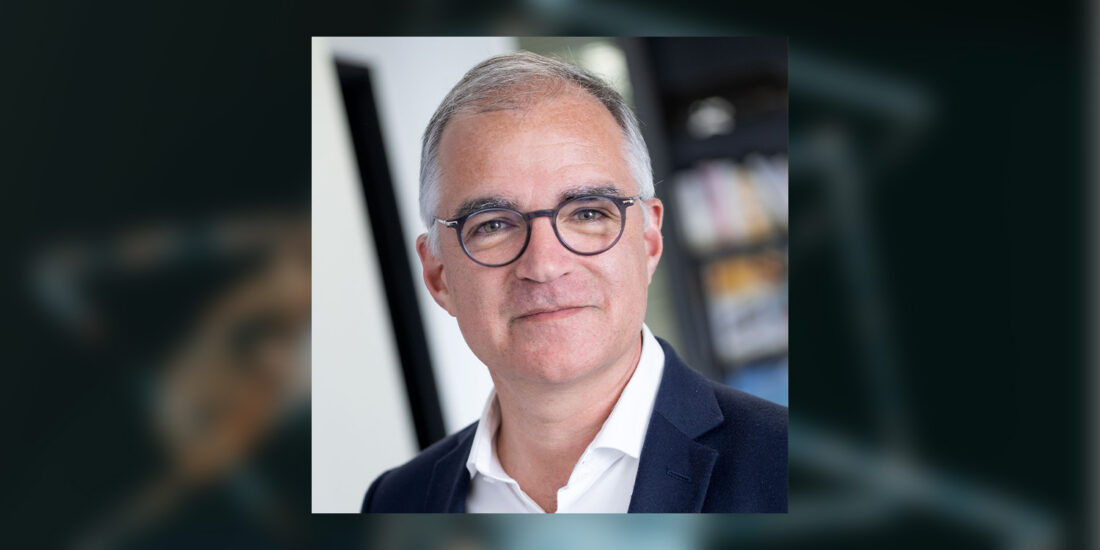
Dr Olivier Guillet of the Institut Supérieur du Droit, France, will present ‘How Can We Justify the Humanities at the Edge of AI?’ at The 5th Paris Conference on Education (PCE2026) and The 5th Paris Conference on Arts & Humanities (PCAH2026) in Paris, France.
Dr Olivier Guillet’s work explores leadership, education, and human development through the dialogue between philosophy and psychology. Drawing on senior roles across leading French institutions, he is well placed to examine what the humanities can still offer in an age of AI: not simply knowledge, but understanding, judgement, and a deeper sense of what it means to become fully human.
This keynote presentation will be held both onsite in Paris and online via live-stream. To participate in PCE/PCAH2026 as an audience member, please register for the conference via the conference website.
The presentation will also be available for IAFOR Members to view online as part of their membership benefits. To find out more about becoming an IAFOR Member, please visit the IAFOR Membership page.
Speaker Biography
Olivier Guillet
Institut Supérieur du Droit, France
 Dr Olivier Guillet is Managing Director of the Institut Supérieur de Droit in Paris, France, where he leads the development of innovative programmes at the intersection of law, education, and leadership.
He previously held senior academic and executive roles, including Dean of International Affairs at EM Lyon Business School, France; Vice Dean of the School of Management and Innovation at Sciences Po, France; and International Director at OMNES Education, France. Across these positions, he has contributed to the design and internationalisation of higher education programmes, working with diverse student populations and global institutional partners.
His research and teaching focus on leadership, with a particular emphasis on the dialogue between philosophy and psychology. His work explores how individuals develop inner coherence, ethical responsibility, and the capacity to act in complex environments.
Dr Guillet is the author of Deep Leadership (2025), a work that proposes a human-centred approach to leadership grounded in intellectual rigour and personal transformation. Alongside his academic career, he is also a trained musician, and continues to draw on music as a source of inspiration for his thinking on harmony, structure, and human expression.

Abstract
How Can We Justify the Humanities at the Edge of AI?
This keynote challenges the very framing of the contemporary debate about the humanities. To ask ‘how can we justify the humanities at the edge of AI?’ is already to concede the argument, accepting a logic of utility and measurable return that the humanities exist precisely to question and balance. The diagnosis offered is not a crisis of knowledge but a crisis of understanding. Western education, and the French Cartesian tradition with particular intensity, has progressively privileged a narrow form of intelligence: analytical, abstractive, procedural. Drawing on Iain McGilchrist’s work on hemispheric attention, the paper argues that we have systematically optimised for what can be formalised and reproduced, while neglecting what can only be perceived, interpreted, and lived. The arrival of artificial intelligence functions as a mirror: machines now excel at precisely the cognitive operations our institutions reward, exposing how much we have been educating humans to be machine-like.
Against this, the keynote proposes that the humanities cultivate three irreplaceable capacities: contextual intelligence, the reading of meaning in situations that resist rules; cognitive lucidity, an honest awareness of the mind’s biases and self-deceptions, drawing on Bronner, Haidt, and Spinoza; and wonder, understood not as naïveté but as openness to a reality richer than our categories. The closing argument reframes the stakes: AI does not threaten the humanities, it clarifies them. The real question is no longer whether the humanities are useful, but what kind of humans we still want to become.
